
Table of Contents
Introduction
Modern manufacturing requires structures that are strong, flexible and easy to assemble. From machine frames and production workstations to equipment enclosures and material handling systems, industrial aluminium profiles provide a practical solution for building modular structures.
Unlike conventional fabricated structures that may require extensive cutting and welding, aluminium extrusion systems can be assembled using compatible connectors, brackets, fasteners and other accessories. This makes it easier to modify, expand or reconfigure structures when production requirements change.
At Swiftin, we offer aluminium profiles and accessories designed to support a wide range of industrial applications. Understanding the available profile types, accessories and selection criteria can help engineers, machine builders and procurement teams make informed decisions.
What Are Industrial Aluminium Profiles?
Industrial aluminium profiles are extruded aluminium sections manufactured with specific cross-sectional shapes. Many modular systems use T-slots that allow accessories and connecting components to be fitted along the profile.
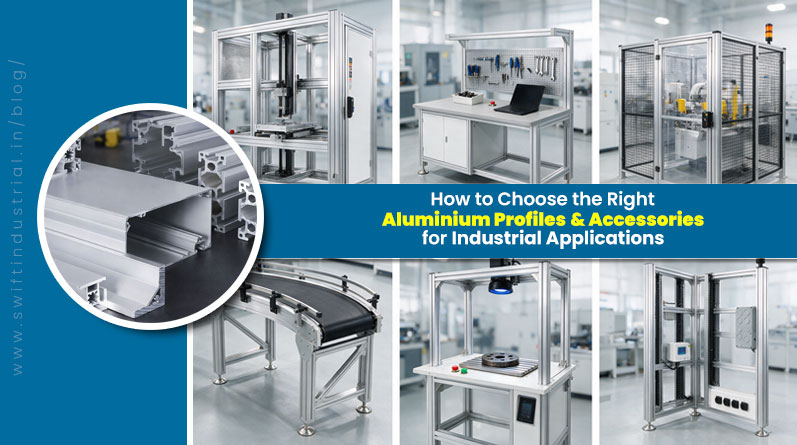
These profiles are commonly used to build:
- Industrial machine frames and equipment structures
- Assembly tables and production workstations
- Machine guarding and safety enclosures
- Conveyor frames and material handling equipment
- Inspection stations and testing fixtures
- Equipment mounting structures and modular partitions
Their modular design allows components to be assembled and adjusted according to the requirements of a particular application.
Explore the Aluminium Profiles and Accessories range from Swiftin to learn more about available solutions.
Types of Aluminium Profiles Used in Industry
Choosing the right profile begins with understanding the application and the structural requirements.
- T-Slot Aluminium Profiles
T-slot profiles feature grooves that accommodate compatible nuts, brackets and connecting accessories. They are widely used in modular industrial framing because components can be positioned and secured without welding the entire structure.
Common applications include machine frames, workbenches, automation equipment, fixtures and enclosures.
- Aluminium Structural Profiles
Structural profiles are used where a frame must support equipment, panels or operational loads. The appropriate profile depends on the load, span, expected deflection, connection method and operating environment.
Engineers should evaluate the complete assembly rather than selecting a profile based only on its external dimensions.
- Special-Purpose Profiles
Certain applications require specific shapes, mounting arrangements or accessory compatibility. Selecting an appropriate profile for the intended application can simplify assembly and reduce the need for unnecessary modifications.
Essential Aluminium Profile Accessories
Accessories play an important role in creating a secure and functional modular structure. Selecting compatible components helps simplify installation and future adjustments.
T-Nuts and Slot Nuts
T-nuts fit into profile slots and provide fixing points for brackets, panels and other components. Depending on the system, different designs may be inserted from the end of a profile or positioned within the slot.
Always check slot dimensions, thread specifications and compatibility before ordering.
Connecting Brackets and Corner Connectors
Brackets and connectors join profiles at corners and intersections. They help create frames, supports, workstation structures and equipment mounting assemblies.
The appropriate connector depends on the joint configuration, required rigidity and expected loading conditions.
Fasteners and Bolts
Bolts and other fastening components secure brackets and accessories to the profiles. Correct thread specifications, engagement and tightening procedures are essential for a reliable assembly.
End Caps and Cover Accessories
End caps and related finishing accessories can improve the appearance of exposed profile ends and help protect against contact with sharp edges. Their suitability depends on the profile design and application.
Panel Mounting Accessories
Suitable panel-mounting components can be used to attach enclosure panels, workstation surfaces and protective screens to modular frames.
For machine guarding, the panel material and mounting arrangement must also meet the machine's safety requirements.
How to Choose the Right Aluminium Profile
Before selecting aluminium profiles and accessories, consider these six factors.
- Application requirements: Determine whether the structure will be used for a machine frame, workstation, enclosure, conveyor or another industrial application.
- Load and span: Consider the weight of equipment, applied forces, unsupported spans and allowable deflection. Structural calculations may be required for load-bearing applications.
- Profile dimensions and slot compatibility: Check the profile series, cross-sectional dimensions, slot size and compatibility with nuts, brackets and connectors.
- Assembly and modification: Consider whether the structure will need regular adjustments, equipment changes or future expansion.
- Operating environment: Evaluate exposure to moisture, chemicals, dust, temperature variations and other environmental factors when selecting materials and finishes.
- Total project requirements: Consider the profiles, accessories, panels, installation effort and future maintenance together rather than comparing profile prices alone.
Aluminium Profiles vs Traditional Steel Fabrication
Aluminium profiles and fabricated steel structures both have important industrial applications. The right choice depends on the project.
Modular aluminium systems can offer convenient assembly, reconfiguration and maintenance access. They may also reduce the need for welding during modifications.
Steel fabrication may be appropriate for applications requiring particular structural capacities, impact resistance or other material-specific properties.
A proper comparison should consider structural performance, material requirements, installation, maintenance and total cost over the service life of the equipment.
Industrial Applications of Aluminium Profiles
Machine Frames and Equipment Structures
Modular profiles can be used to construct equipment frames and supporting structures. Profile selection must account for machine loads, vibration, alignment and operating conditions.
Production Workstations
Manufacturers can use aluminium profiles to create assembly benches, tool holders, material racks and operator workstations. Modular construction can make future layout changes easier.
Machine Guarding and Safety Enclosures
Aluminium profiles can form the framework for machine enclosures and protective barriers. Appropriate guarding panels, access doors, interlocks and other safety features must be selected according to the machine's risk assessment.
Material Handling Systems
Profiles can support conveyor frames, guide structures, sensor mounts and other auxiliary components. The design must account for operating loads and the requirements of the complete system.
Common Mistakes to Avoid
- Choosing profiles based only on price or external dimensions.
- Using incompatible T-nuts, brackets or fasteners.
- Ignoring deflection and connection strength.
- Overlooking panel mounting and access requirements.
- Failing to consider future expansion or maintenance.
- Treating a modular frame as a substitute for a complete machine safety assessment.
A well-planned profile system should be designed around the requirements of the finished assembly.
Frequently Asked Questions
What are aluminium profiles used for in industry?
Industrial aluminium profiles are used for machine frames, workstations, equipment enclosures, material handling structures, fixtures and modular support systems.
What are T-slot aluminium profiles?
T-slot aluminium profiles feature grooves that accommodate compatible nuts and accessories. They allow components to be connected and adjusted to build modular structures.
Which accessories are needed for aluminium profiles?
Common accessories include T-nuts, slot nuts, connecting brackets, corner connectors, bolts, fasteners, end caps and panel-mounting components. The exact selection depends on the profile system and application.
Are aluminium profiles suitable for machine guarding?
They can be used to build machine-guarding frames. However, the complete guarding system must provide suitable protection and meet applicable machinery safety requirements.
How do I select the right aluminium profile size?
Consider the application, loads, unsupported spans, deflection limits, slot compatibility, connection design and operating environment. Obtain engineering guidance when structural performance is critical.
Conclusion
Industrial aluminium profiles provide a flexible foundation for modular manufacturing structures. With the right profiles, connectors and accessories, businesses can build practical solutions for machine frames, workstations, enclosures and material handling applications.
Successful selection requires more than choosing a profile dimension. Compatibility, structural requirements, ease of assembly and long-term maintenance should all be considered before finalising a design.
Looking for reliable aluminium profiles and accessories for your industrial project?
Contact Swiftin to discuss your requirements and identify suitable components for your application.
- Email: sales@swiftindustrial.in
- Phone: +91 98904 88859
Explore our solutions and get in touch with our team for product information and assistance with your industrial requirements.
