
Table of Contents
Choosing the right frame material is one of the most consequential decisions an engineering or manufacturing team makes when designing machine enclosures, workstations, conveyor systems, or automation cells. Get it wrong, and you're stuck with excess weight, rising maintenance costs, or a structure that simply can't keep pace with your production environment.
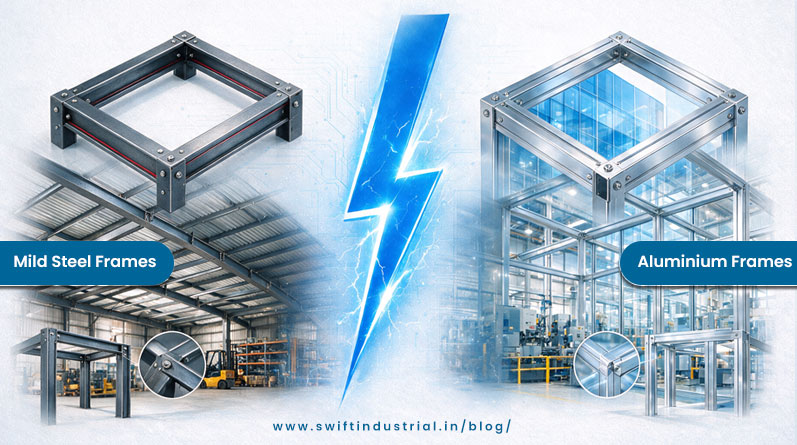
Two materials dominate this decision: aluminium and mild steel. Both have earned their place in industrial applications, but they serve very different purposes depending on your load requirements, environment, budget, and long-term operational goals.
In this guide, we break down the real differences between aluminium and mild steel frames so you can make an informed, cost-effective choice for your facility.
Why Frame Material Selection Matters
Industrial frames aren't just structural support — they directly affect equipment lifespan, energy efficiency, installation time, and total cost of ownership. A frame that corrodes prematurely or adds unnecessary dead weight to a moving assembly can quietly drain your maintenance budget and slow down production for years.
That's why industries ranging from automotive and pharmaceuticals to food processing, electronics, and heavy machinery are re-evaluating their frame material choices — and increasingly leaning toward modular, engineered solutions over traditional fabrication.
Aluminium Frames: Strength Without the Weight
Factor
Aluminium Frames
Mild Steel Frames
Weight
Lightweight (~1/3 of steel)
Heavy
Corrosion Resistance
Excellent (natural oxide layer)
Poor (needs coating)
Strength-to-Weight Ratio
High
Moderate
Load-Bearing Capacity
Moderate to High
Very High
Assembly
Modular, bolt-together
Typically welded
Maintenance
Minimal
Regular (rust prevention)
Reconfigurability
High
Low
Best For
Workstations, automation, cleanrooms
Heavy bases, static structures
How to Choose the Right Frame Material for Your Industry
Selecting between aluminium and mild steel ultimately comes down to three questions:
1. How much weight will the frame carry, and how often will it move? Static, heavy loads favor steel. Mobile or lightweight assemblies favor aluminium.
2. What environment will it operate in? Washdown areas, cleanrooms, and humid conditions favor aluminium's corrosion resistance.
3. How often will the structure need to be modified? If your production line evolves frequently, aluminium's modular profile systems save significant time and cost over the equipment's life.
Many manufacturers today are adopting hybrid designs — using mild steel for foundational load-bearing frames and aluminium profiles for enclosures, guarding, and modular workstations built on top. This approach balances raw strength with flexibility and reduces overall system weight.
For automated production lines, pipe-and-joint systems and Pipe and Joints solutions also offer a middle ground — combining steel-grade strength with the modularity typically associated with aluminium.
Why Engineering Teams Trust Swiftin for Frame Solutions
At Swiftin, we've spent decades helping manufacturing, automotive, pharmaceutical, and electronics companies select and engineer the right frame systems for their production environments. Whether you need precision-extruded aluminium profiles for a cleanroom workstation or a custom structural solution for heavy machinery, our team helps you evaluate load requirements, environmental conditions, and budget to recommend the best-fit material — not just the easiest sell.
Explore our complete range of Aluminium Profiles and Accessories, Aluminium Structures and Workstations, and Pipe and Joints systems, or browse our full Products catalog to find the right fit for your facility.
Frequently Asked Questions
Is aluminium as strong as mild steel?
Aluminium has a lower absolute strength than mild steel, but a higher strength-to-weight ratio. For applications where weight matters as much as strength — such as workstations and moving assemblies — aluminium often outperforms steel in practical terms.
Which material is more cost-effective long-term?
While mild steel may have a lower upfront material cost for large structures, aluminium's low maintenance and corrosion resistance often make it more cost-effective over the equipment's lifetime, especially in humid or washdown environments.
Can aluminium and mild steel be combined in one structure?
Yes. Many industrial setups use mild steel for the load-bearing base and aluminium profiles for enclosures, guarding, and reconfigurable workstation elements — combining the strengths of both materials.
Which industries benefit most from aluminium frames?
Pharmaceutical, food processing, electronics, and automation-heavy industries benefit most due to aluminium's corrosion resistance, cleanroom compatibility, and modular flexibility.
Get Expert Guidance on Your Frame Selection
Still unsure whether aluminium, mild steel, or a hybrid structure is right for your application? Our engineering team can review your load specifications, environment, and production goals to recommend a solution that reduces downtime and total cost of ownership.
Request a Free Consultation or Call Us Now to speak with a Swiftin engineering specialist today.
