Table of Contents
When building industrial structures — workstations, machine guards, frames, or material handling systems — the material system you choose directly impacts build speed, cost, maintenance, and long-term flexibility. Steel, aluminium profiles, and pipe-and-joint systems each have a distinct role, and the right choice depends on your load requirements, reconfiguration needs, and project constraints.
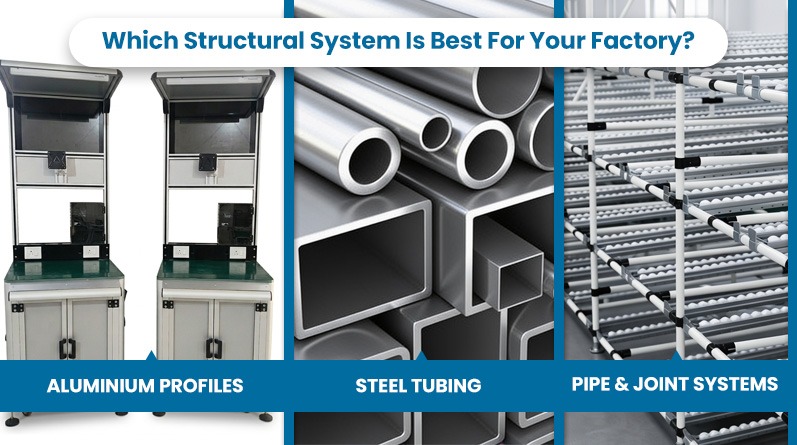
This guide compares three widely used structural systems in Indian manufacturing environments:
- Modular Aluminium Profiles (T-slot extrusions)
- Steel Tubing (welded/fabricated)
- Pipe & Joint Systems (ABS Coated lean tubing)
By the end, you will clearly understand which system best fits your specific requirements—and how Swiftin can help you implement it effectively.
Aluminium Profiles — The Modular Powerhouse
Modular Aluminium Profiles (also known as Aluminium Extrusions) have become the go-to structural system for modern, precision-driven industrial setups. Their modular design enables rapid assembly, easy modification and long-term flexibility without welding or extensive fabrication
Key Advantages
- High Strength-to-Weight Ratio — strong yet lightweight, easing handling and reducing floor load
- Corrosion-Resistant — no rust, no paint chipping, ideal for cleanrooms and outdoor enclosures
- Fully Modular — T-nut system allows fast reconfiguration as processes evolve
- Precision Fitment — consistent tolerances across connectors, brackets, and fasteners
- Clean Aesthetics — professional finish for customer-facing areas and ISO-compliant zones
Ideal Applications
- Machine frames and enclosures
- Assembly and inspection workstations
- Industrial Safety Fencing and access panels
- Conveyor Structures and automation frames
Swiftin's Aluminium Profile range includes a full ecosystem of accessories — connectors, levelling bases, die-cast brackets, T-nuts, T-slot covers, and fasteners — enabling rigid, rapid builds with minimal tooling.
Steel Tubing — High Load, High Labour
Steel tubing and fabricated steel structures remain relevant for heavy-duty structural applications where sheer load capacity is the primary concern. However, they come with significant trade-offs that can inflate project timelines and costs.
Key Advantages
- Exceptional load-bearing capacity for very heavy machinery bases
- Well-established fabrication ecosystem across India
- Cost-effective for large raw material volumes
Key Limitations
- Welding required — skilled labour dependency, longer lead times
- No reconfigurability — changes require cutting, re-welding, and repainting
- Heavy weight — increases material handling difficulty
- Susceptible to corrosion — requires surface treatment, ongoing maintenance
- Poor precision — weld-based assemblies have higher dimensional variance
Best For
- Heavy machine bases and structural columns
- Applications where load exceeds what Modular Aluminium Structures can handle
While steel remains the preferred choice for heavy structural applications, many workstation, guarding and automation projects can benefit from more modular alternatives that offer faster assembly and easier future modifications.
Pipe & Joint Systems — Lean and Ergonomic
Pipe and Joint Systems (also called Lean Tube or Kaizen Tubing) use lightweight aluminium pipes with push-fit or screw-tighten joints. They are a cornerstone of Lean Manufacturing Workstations and ergonomic shop floor design.
Key Advantages
- Extremely fast, tool-free assembly
- Highly ergonomic — adjustable height and angles
- Lightweight and easy to reconfigure as production layouts change
- Ideal for gravity flow racks, trolleys, and mobile carts
Key Limitations
- Lower load capacity vs aluminium profiles or steel
- Less rigid for large-span structures
- Primarily suited for light material handling, not machine framing
Best For
- Lean manufacturing layouts (Kaizen, 5S environments)
- Gravity flow racks and picking stations
- Mobile trolleys and ergonomic operator stations
Swiftin's Pipe & Joint range includes a wide variety of connectors and tube sizes for both static and mobile lean structures — built for Indian shop floor conditions.
Quick Comparison: At a Glance
Criteria
Aluminium Profiles
Steel Tubing
Pipe & Joint Systems
Weight
Lightweight
Heavy
Heavy
Corrosion Resistance
Excellent
Poor (needs coating)
Good (ABS Coated)
Modular / Reconfigurable
Fast (no welding)
Slow (welding required)
Fast (tool-free)
Assembly Speed
Fast (no welding)
Slow (welding required)
Fast (tool-free)
Precision & Aesthetics
High — clean finish
Moderate
Moderate
Load Capacity
High
Very High
Moderate
Cost (Long-term)
Low TCO
High (labour + rework)
Low–Medium
Best For
Workstations, frames, guarding
Heavy structural work
Lean/ergonomic layouts
Quick Selection Guide
If You Need
Recommended System
Machine Frames
Aluminium Profiles
Operator Workstations
Aluminium Profiles
Safety Fencing
Aluminium Profiles
Flow Racks
Pipe & Joint Systems
Material Trolleys
Pipe & Joint Systems
Heavy Machine Bases
Steel Tubing
Structural Columns
Steel Tubing
Conveyor Structures
Aluminium Profiles
Automation Cells
Aluminium Profiles
Common Applications by Industry
Industry
Common Applications
Automotive
Assembly Workstations, Conveyor Structures, Industrial Safety Fencing
Electronics
ESD Workstations, Inspection Tables, Lean Flow Racks
Engineering & Manufacturing
Machine Frames, Automation Cells, Testing Stations
Which System Should You Choose?
Choose Aluminium Profiles if you need a precision-built, modular structure for Aluminium Workstation Systems, Machine Guarding Systems, or automation frames — where reconfigurability, clean finish, and long-term ROI matter.
Choose Steel Tubing only when you're dealing with extreme loads or static structural applications where welded permanence is acceptable — and you have access to skilled fabricators.
Choose Pipe & Joint Systems when you're implementing Lean Manufacturing Workstations, ergonomic flow racks, or mobile carts that need to be rearranged frequently with minimal tools or investment.
In many advanced manufacturing environments, Aluminium Profiles and Pipe & Joint Systems are used together — profiles for fixed frames and enclosures, pipe-joint for ergonomic operator stations and flow racks.
Total Cost of Ownership Matters More Than Initial Cost
Many manufacturers compare only material cost when selecting a structural system. Fabrication, labour, installation time, future modifications, maintenance, and downtime often have a greater impact on project cost than the raw material itself.
A modular Aluminium Profile system may have a higher initial material cost than fabricated steel — but it consistently delivers a lower total cost of ownership through faster assembly, easier modifications, and reduced maintenance over time.
Why Choose Swiftin for Your Structural Systems?
- Complete Range Of Aluminium Profiles & Accessories
- Pipe & Joint Systems For Lean Manufacturing
- Engineering Support For System Selection
- Custom Design & Assembly Capabilities
- Safety Fencing & Machine Guarding Solutions
- Conveyor & Automation Structure Expertise
- Pan-India Supply & Project Support
Ready To Select The Right Structural System?
Swiftin Corporation LLP offers a complete range of Modular Aluminium Profiles, Accessories, and Pipe & Joint Systems — Designed and engineered to meet the needs of Indian industries.
Contact our engineering team today to find the right structural solution for your application.
