
Table of Contents
If you are planning to build a machine frame, operator workstation, safety guard, or any industrial structure, aluminium profiles are likely your best starting point. They are strong, lightweight, modular, and endlessly reconfigurable. But before you can order anything, you need to answer one critical question: which size and series is right for your application?
This beginner's guide will walk you through the standard aluminium profile sizes, the most common series, and how to match the right profile to your industrial requirements — so you get it right the first time.
What Are Aluminium Profiles?
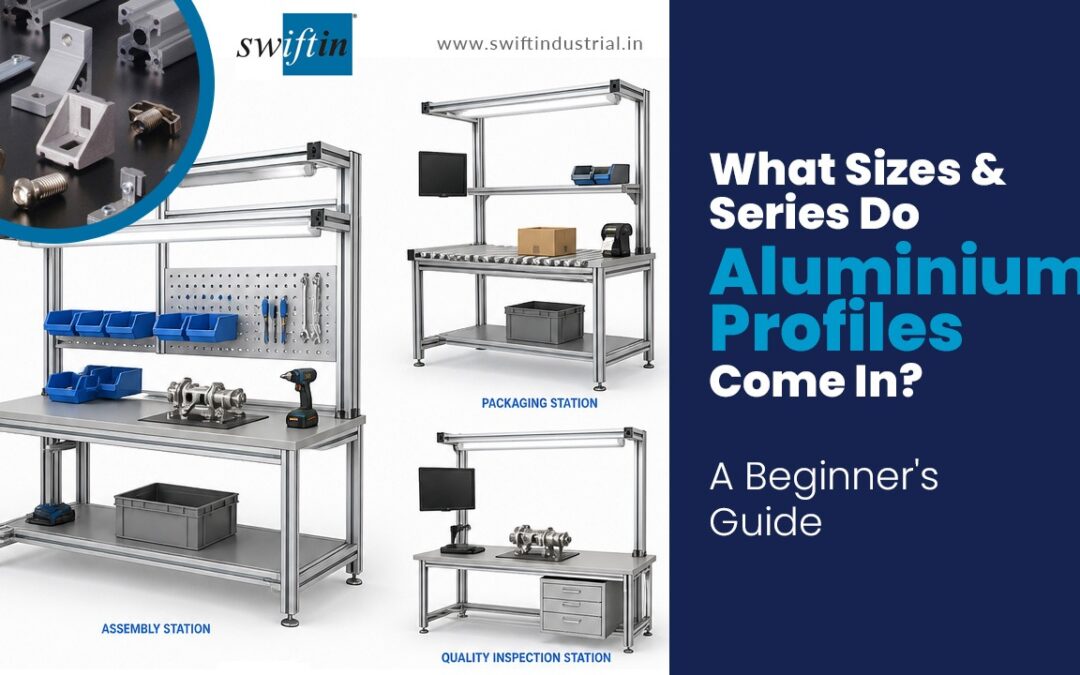
Aluminium profiles — also called aluminium extrusions or T-slot profiles — are precision-extruded structural components used to build industrial frames, enclosures, workstations, guarding systems, and automation structures. Their T-slot channels allow bolts, brackets, and accessories to be inserted and repositioned anywhere along the length, making them far more flexible than welded steel structures.
They are widely used across manufacturing, automotive, food processing, pharmaceutical, electronics, and logistics industries across India.
Understanding Profile Sizing: What Do the Numbers Mean?
Aluminium profiles are identified by their cross-sectional dimensions — typically expressed in millimetres as width x height. A profile labelled 40x40 means it measures 40 mm on each side. Common sizes include:
- 20x20 mm: Light-duty enclosures, small frames, prototype structures
- 30x30 mm: Medium-duty guarding, display stands, compact workstations
- 40x40 mm: Most popular — machine frames, operator stations, industrial racking
- 40x80 mm: Rectangular profiles for panels, conveyor frames, and cantilever beams
- 45x45 mm: Heavy-duty structures, automation equipment, and SPM frames
- 60x60 mm: High-load bearing structures and large machine enclosures
- 80x80 mm: Very heavy industrial frameworks requiring high rigidity
The choice of size directly determines the load-bearing capacity, aesthetics, and the range of compatible accessories available.
Aluminium Profile Series: What Is the Difference?
Beyond size, aluminium profiles are classified by series, which defines the slot width, groove geometry, and compatible hardware. The most common series you will encounter are:
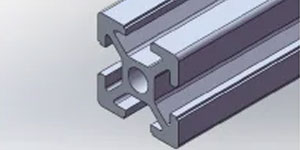
Series 20 (Slot Width: 5 mm)
Designed for miniature and light-duty applications. Ideal for small enclosures, display frames, and educational or R&D setups. Uses M4 fasteners. Profile sizes: 20x20 mm.
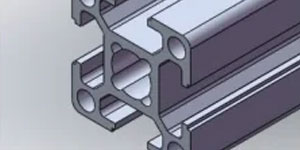
Series 30 (Slot Width: 6 mm)
Used for medium-load applications such as small machine guards and instrument frames. Compatible with M5 and M6 fasteners. Profile sizes: 30x30, 30x60 mm etc.
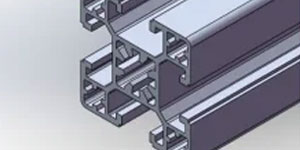
Series 40 (Slot Width: 8 mm) — Most Popular
The industry standard for most manufacturing and automation environments. Offers exceptional strength-to-weight ratio, a wide range of compatible accessories, and versatility across nearly all industrial applications. Compatible with M8 fasteners. Profile sizes: 40x40 SL, 40x40 L mm etc.
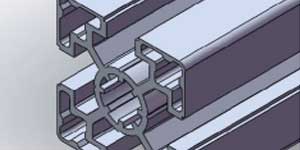
Series 45 (Slot Width: 10 mm)
Designed for heavy-duty industrial structures with higher load demands. Commonly found in automation systems, special purpose machines (SPMs), and precision assembly lines. Compatible with M8 and M10 fasteners. Profile sizes: 45x45, 45x90 mm etc.
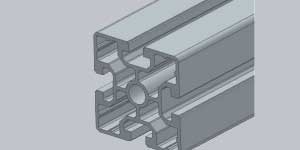
Series 60 and Series 80 (Heavy-Duty)
For very heavy-duty structures requiring maximum rigidity and load capacity — large machine beds, conveyor frameworks, and structural supports. Uses M10 and M12 fasteners.
How to Choose the Right Aluminium Profile for Your Application
Choosing the correct profile comes down to four key factors:
- Load requirements: Heavier loads require larger profiles and higher series numbers.
- Structure type: A lightweight guard may need a 30-series; a machine base typically needs 40-series or above.
- Accessory compatibility: Ensure all connectors, hinges, brackets, and panels you plan to use are rated for the same series.
- Available space: Profile cross-section must suit the installation envelope — smaller profiles for compact spaces.
When in doubt, the 40-series 40x40 mm profile is the safest starting point for most industrial applications in India.
Aluminium Profiles vs. Steel: Why Industries Are Switching
More Indian manufacturers are shifting from welded steel to modular aluminium profiles for good reason:
- No welding required — faster assembly and disassembly
- Corrosion-resistant — ideal for food, pharma, and cleanroom environments
- Reconfigurable — layouts can be changed without new fabrication
- Cleaner aesthetics — professional appearance on the shop floor
- Lower long-term cost — reusable components reduce replacement expenses
Final Thoughts
Aluminium profiles come in a wide range of sizes — from compact 20x20 mm sections to heavy-duty 80x80 mm beams — and series from Series 20 to Series 80. Each combination is engineered for a specific load range, application type, and accessory ecosystem. The key is to match the profile to your structural need rather than defaulting to what is most familiar.
Whether you are setting up a new production line, upgrading an operator workstation, or designing a machine enclosure from scratch, the right aluminium profile will save you time, reduce rework, and deliver long-term structural reliability.
Swiftin's team of engineering experts is here to guide you every step of the way — from profile selection to complete structural assembly. Get in touch today and let us help you build smarter.
Ready to Build with the Right Aluminium Profile?
Swiftin has been supplying industrial-grade aluminium profiles across India since 2006. Our technical team helps you select the right size, series, and accessories for your exact application — so your structure is built right the first time.
