
Table of Contents
Introduction
Manufacturing facilities need equipment structures that support efficient production while helping protect workers from machinery hazards. Machine guarding and industrial workstations are two important applications where modular aluminium profiles can provide a flexible construction solution.
Aluminium profile systems allow engineers and machine builders to create frames for protective enclosures, assembly benches, inspection stations and production equipment. Their modular design can make assembly, maintenance and future modifications more convenient.
For manufacturers planning a new production line or upgrading existing equipment, aluminium profiles can offer an alternative to conventional fabricated structures.
In this guide, we explore how aluminium profiles are used in machine guarding and industrial workstations, their key benefits, and the factors to consider when selecting a suitable solution.
What Is Aluminium Profile Machine Guarding?
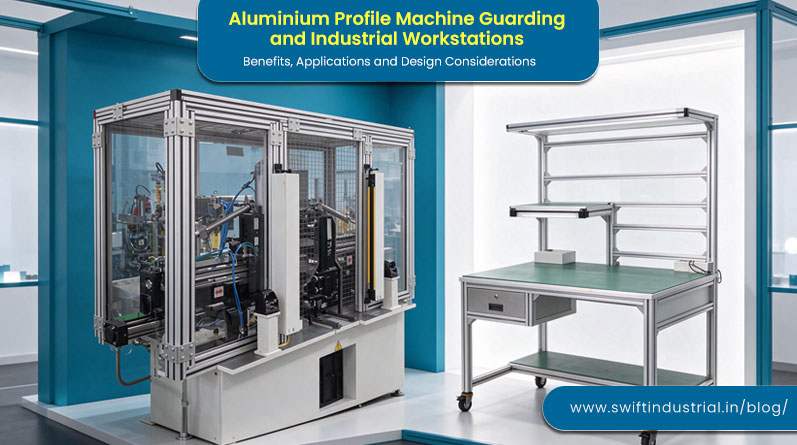
Aluminium profile machine guarding uses modular aluminium extrusions to construct the framework of a protective enclosure or barrier around industrial machinery.
Depending on the application, the frame may support mesh panels, transparent polycarbonate panels, metal sheets or other suitable guarding materials.
These structures can be used around:
- Automated production machinery
- Assembly and packaging equipment
- Conveyor systems
- Robotic work cells
- Testing and inspection equipment
- Manufacturing and processing machines
The design depends on the hazards present, machine operation, maintenance requirements and applicable safety standards.
Aluminium profiles provide the structural framework, but the complete guarding system must be designed to provide the required level of protection.
Key Benefits of Aluminium Profile Machine Guarding
- Modular Construction
One of the main advantages of modular profile systems is the ability to assemble frames using compatible connectors and fasteners.
This can simplify the construction of enclosure frames and allow certain components to be repositioned or replaced when production requirements change.
- Easier Maintenance and Modifications
Industrial equipment often needs maintenance, upgrades or layout changes. A suitably designed modular frame can make it easier to remove panels, access equipment and modify enclosure configurations.
However, modifications must not compromise the guarding function or machine safety.
- Flexible Enclosure Design
Different machines require different enclosure shapes, panel arrangements and access points. Aluminium profiles allow designers to configure frames according to the machine layout and available floor space.
Panel selection and access arrangements should be finalised after assessing the relevant hazards.
- Integration with Industrial Equipment
Profile frames can accommodate suitable mounting arrangements for panels, cable management, sensors and other supporting components.
Where adjustable operator interfaces are required, a compatible industrial support arm system may also be useful. Explore Support Arm Systems for related industrial mounting solutions.
- Cleaner Assembly and Reconfiguration
Modular framing can reduce the need for welding during assembly and subsequent modifications. This can be useful for manufacturers that regularly reconfigure production equipment or introduce new products.
The actual installation effort depends on the structure, connectors, panels and assembly method.
Essential Design Considerations for Machine Guarding
Selecting aluminium profiles is only one part of designing an effective machine-guarding system.
Identify the Machinery Hazards
Start by assessing the machine and identifying hazards such as moving components, rotating parts, pinch points, flying debris and other potential sources of injury.
The guarding solution should be designed around the identified risks rather than a standard frame configuration alone.
Select Appropriate Guarding Panels
Depending on the application, suitable panels may include:
- Wire mesh for applications requiring visibility and ventilation.
- Polycarbonate panels where appropriate impact resistance and visibility are required.
- Metal panels where a more enclosed barrier is needed.
Material selection must account for the specific hazards, impact requirements, chemical exposure and operating conditions.
Plan Access Doors and Interlocks
Maintenance and operator access must be considered during the design stage. Where required by the risk assessment, access doors may need safety interlocks or other protective measures.
Opening a guard must not expose workers to uncontrolled hazardous machine movement.
Consider Profile Strength and Connections
The frame must support the panels and withstand the forces reasonably expected in its intended application. Profile dimensions, connector strength, unsupported spans and fixing arrangements all influence performance.
Follow Applicable Safety Requirements
Machine guarding must comply with applicable machinery safety requirements and standards. The design should be reviewed by qualified personnel, particularly where machinery presents significant risks.
A modular aluminium profile frame should never be assumed to provide adequate safety simply because it encloses a machine.
Aluminium Profile Workstations for Modern Manufacturing
Industrial workstations are another application for modular aluminium profiles. They provide a framework for assembling products, performing inspections, handling components and supporting production activities.
A workstation may include a work surface, storage shelves, tool holders, lighting mounts, monitor supports and other accessories, depending on the operation.
Assembly Workstations
Assembly workstations can be configured around the sequence of production tasks. Modular structures allow manufacturers to adjust component placement and workstation layouts as processes evolve.
Inspection and Testing Stations
Profiles can be used to construct frames for inspection equipment, gauges, fixtures and other testing components. Stability, vibration and mounting accuracy should be considered where measurement precision matters.
Packaging Workstations
Packaging stations may incorporate storage bins, label printers, monitor mounts and material supports. A modular design can help organise tools and materials around the workflow.
Operator Workstations
Workstations can be designed with suitable working heights, equipment placement and access to tools. Ergonomic requirements should guide the final configuration to help reduce unnecessary reaching, bending and repetitive strain.
How to Design an Efficient Aluminium Profile Workstation
- Understand the Workflow
Identify the tasks performed at the workstation, the materials handled and the sequence of operations. The layout should support efficient movement and convenient access to tools.
- Determine the Load Requirements
Consider the weight of the work surface, equipment, stored materials and any forces applied during operation. Profile dimensions and connectors must be selected for the intended loading conditions.
- Plan Accessories and Storage
Suitable brackets, mounting plates, shelves, tool holders and fasteners can help create an organised workstation.
For compatible components, refer to the Swiftin Aluminium Profiles and Accessories range.
- Consider Ergonomics
Work surface height, monitor positioning, lighting and reach distances should be appropriate for the tasks and users. Adjustable features may be beneficial where different operators share the workstation.
- Allow for Future Changes
Manufacturing processes evolve. A modular workstation can make certain changes easier, provided the new configuration remains structurally suitable and safe.
Aluminium Profile Machine Guarding vs Steel Fabricated Structures
Both aluminium profile systems and fabricated steel structures can be used in industrial applications. The best option depends on the project.
Aluminium profile systems may be suitable when:
- Modular assembly is important.
- Frequent reconfiguration is expected.
- Components need to be repositioned or replaced.
- A standardised modular framing system suits the design.
Steel fabrication may be suitable when:
- The application requires specific structural properties.
- High impact or demanding loading conditions must be addressed.
- The design requires custom fabricated components.
The comparison should include structural performance, installation, maintenance, material suitability and total lifecycle cost. For machine guarding, safety requirements must take precedence over convenience or cost.
Common Applications Across Manufacturing Industries
Aluminium profile machine guarding and workstations can support operations in several sectors, including:
Automotive manufacturing: Equipment enclosures, assembly fixtures and production workstations.
Electronics manufacturing: Assembly stations, inspection frames and suitable equipment enclosures.
Packaging and processing: Conveyor support frames, access barriers and packaging stations.
General engineering: Machine frames, testing fixtures, component assembly benches and inspection stations.
Industrial automation: Modular frames supporting automation equipment, sensors and protective enclosures.
The suitability of each solution depends on the machine, process, loading conditions and safety requirements.
Frequently Asked Questions
What are the benefits of aluminium profile machine guarding?
Aluminium profile machine guarding can provide modular construction, flexible enclosure layouts and convenient access for certain maintenance and modification tasks. The completed system must still meet the applicable safety requirements
Can aluminium profiles be used for industrial workstations?
Yes. Suitable aluminium profiles can be used to construct assembly benches, inspection stations, packaging workstations and equipment support frames. The profile and connector selection should reflect the intended loads and working conditions.
Which panels can be used with aluminium machine-guarding frames?
Depending on the application, frames may support mesh, polycarbonate or metal panels. The appropriate choice depends on the identified hazards, impact requirements, visibility needs and operating environment.
Are aluminium profile workstations easy to modify?
Modular workstations can often be adjusted by repositioning or replacing compatible components. Any modification must preserve structural stability and safe operation.
How do I choose the right aluminium profiles for machine guarding?
Consider the enclosure dimensions, panel weight, loading conditions, connection strength, access arrangements and machine hazards. A qualified designer should evaluate the complete guarding system.
Conclusion
Aluminium profiles provide a versatile option for constructing modular machine-guarding frames and industrial workstations. They can support flexible enclosure layouts, organised production stations and structures that accommodate future changes.
The key to a successful installation is choosing suitable profiles and accessories while accounting for structural performance, operator requirements, maintenance access and machinery safety.
Whether you are building a new production workstation, upgrading an equipment enclosure or planning a modular manufacturing structure, careful design can help create a solution that meets your operational needs.
Looking for Aluminium Profiles and Industrial Structural Solutions?
Swiftin supports industrial requirements with aluminium profiles and accessories for modular structures and equipment applications.
Visit our website to explore the available solutions:
- Aluminium Profiles & Accessories: https://www.swiftindustrial.in/swiftin-corporation-llp/aluminium-profile-and-accessories/
- Related industrial mounting solutions: https://supportarmsystemsindia.com/
- Email: sales@swiftindustrial.in
- Phone: +91 98904 88859
Contact Swiftin to discuss your project requirements and identify suitable aluminium profile components for your application.
